
2022, July 18
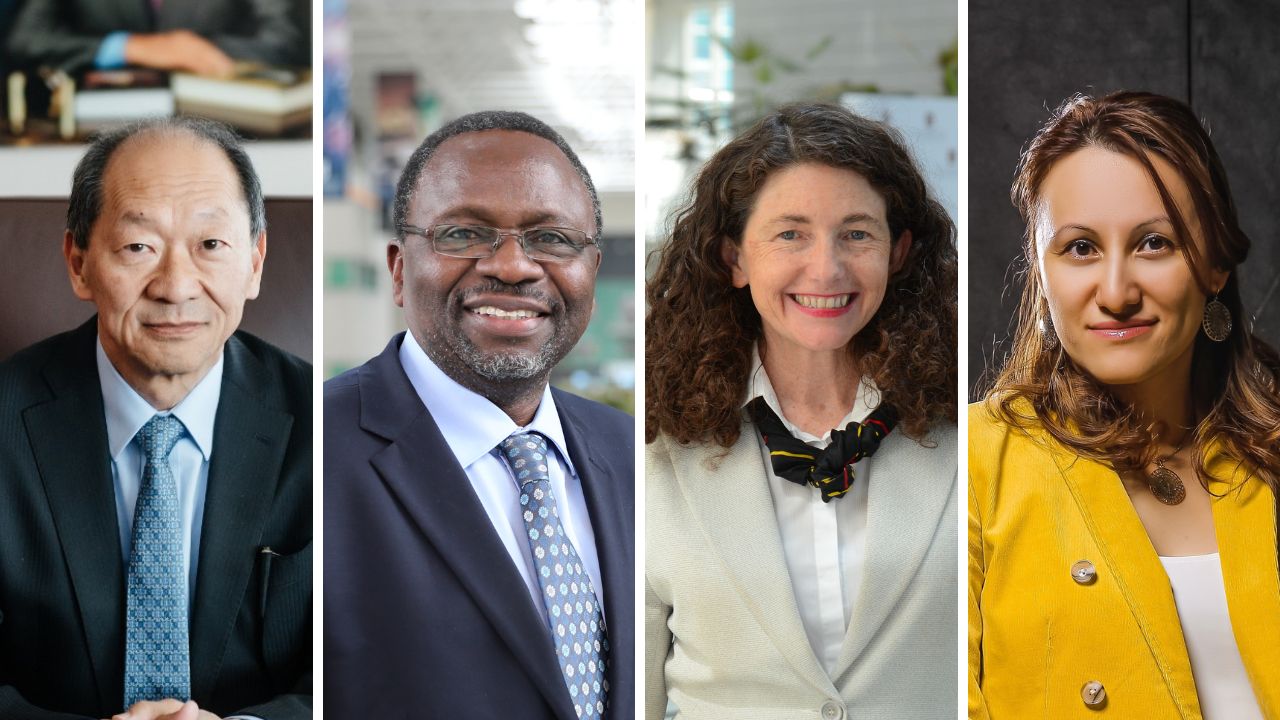
Share this articleNU President Shigeo Katsu, NU Provost Ilesanmi Adesida, NU Vice-provost Loretta O'Donnell, and Head of the NU Office of Global Relations Aliya Kaimoldinova contributed to this article published by the International Universities Association (IAU).
Where to start?
The COVID-19 pandemic that broke out globally some two years ago has wrought havoc on the higher education (HE) landscape and forced sudden and far-reaching changes. Some say that universities are conservative institutions that deeply resist change, yet that from time to time do come up with radical ideas. Maybe this is one of those times that usher in real changes. What are some of the changes HE has experienced?
Some changes HE grappled with included (by no means exhaustive):
Digitalization and online delivery of courses was forced upon higher education systems, but it was then actually accepted and even embraced.
Empty campuses deeply affected student experience; the building of communities, a central element of campus life, has become a huge challenge.
At research universities, laboratory-intensive research skidded to a sudden standstill.
Online course providers suddenly became credible alternatives to traditional higher education institutions (HEIs).
Student mobility took a major hit, and with it the exchange of young talented minds.
Many HEIs have been forced to invent different business models to ensure survival.
There is hope that society’s trust in science has been rekindled through the real-time response to COVID-19 (vaccines and treatment protocols).
But devastating mental health issues leave a long-lasting legacy for the global society as well as HEIs.
What will Higher Education X.0 look like?
Post-COVID higher education cannot and will not be simply a return to the pre-COVID world. HEIs must draw lessons from the above and countless other experiences to ensure their survival in a VUCA world (more volatile, unpredictable, complex, and ambiguous). Whether the outcome of the reflections will be called HE2.0 or 4.0 or something else is not really important, but the underlying principles and path-determining elements are.
So, what are some of the signposts?
HEIs will continue to be value-driven: Integrity (both research and academic integrity), intellectual curiosity, tenacity, resilience, persistence, and open access to knowledge will remain essential as higher education’s vocation to educate and nurture citizens in a holistic way will endure.
The need for more diversity is plain to see. Society will call for a variety of HEIs:
Evidence that good ideas come from everywhere, not just from established institutions, and that talent can be found in all corners of the globe will fuel the emergence of alliances and networks to liberate human capital – intellectually, professionally, and with integrity. Governments and policy makers must minimize barriers to these deep collaborations.
Higher education will be increasingly student-centered, with faculty becoming facilitators and guides along the students’ individual learning journey.
HEIs’ role in fostering economic mobility at the intersection of education and the economy and supporting the development of a middle class will remain. But access issues, including financial affordability, will continue to loom large.
HEIs need to be seen as communities: if it takes a village to raise a child, it takes the entire university to educate a student, and it takes a network of collaborative universities to educate a global society. Student-centered learning models, fostering social interaction, and serving as the locus for civic debate and intellectual exploration are essential for HEIs to impart value. Integrity and intellectual curiosity have proven to be elemental, universal, and timeless, and are the glue to hold the HEI community together during difficult times. Knowledge creation and dissemination must accelerate and at the same time be more creative than ever before, stretching across disciplines, generations, and geographic boundaries. The ability to reframe problems to create opportunities, especially in a VUCA world, will be a critical hallmark of success for HEIs.
Here is the link to the original article.