
2023, July 11
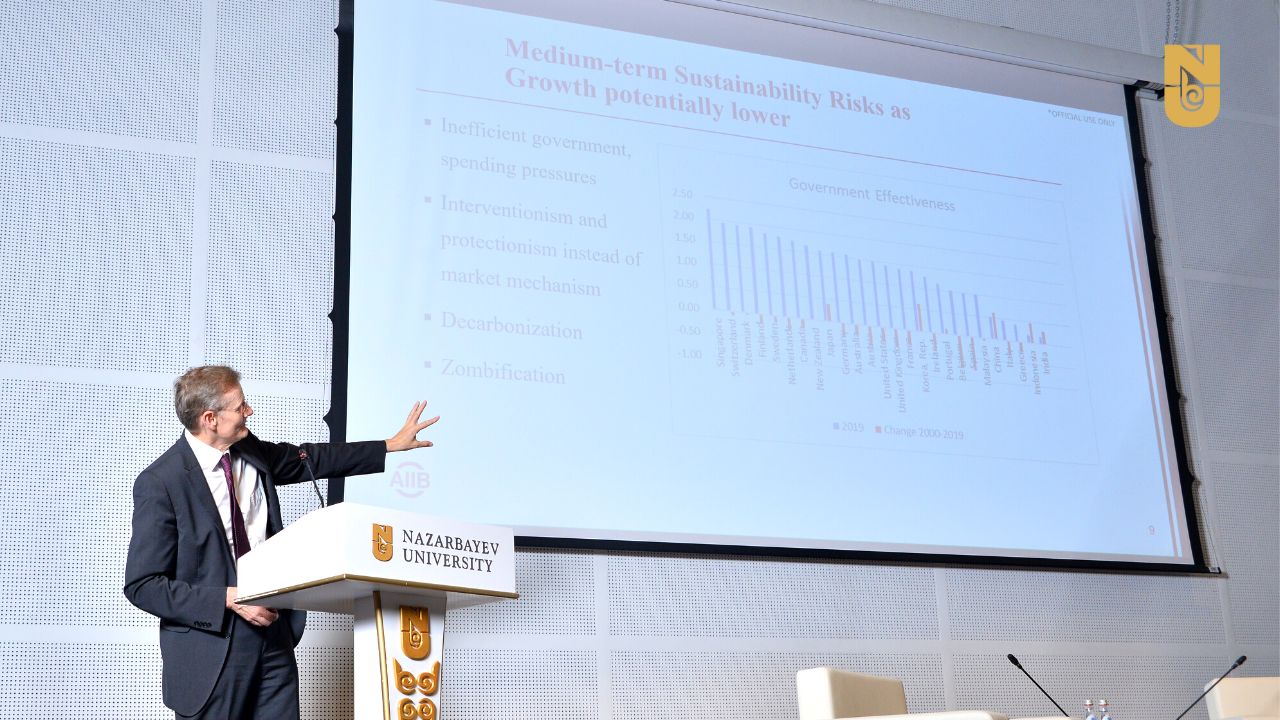
Share this articleVice President of the Asian Infrastructure Investment Bank gave a lecture at NU, where he spoke about economic challenges, the problem of national debt, and the possibilities of decarbonizing the economy.
On July 11, Ludger Schuknecht, Vice President and Corporate Secretary of the Asian Infrastructure Investment Bank (AIIB) gave a lecture on the “Role of international financial institutions in promoting the development of Kazakhstan based on the country’s economic, cultural, and social potential,” during which he raised the issue of the fragmentation of the challenges facing the global economy today. He highlighted several current challenges, including the consequences of the pandemic, global economic and political instability, protectionism, and the countries lacking clear investment and social development goals, while also pointing out the need to focus on future major challenges such as climate change and population risks.

According to the expert, one of the major problems today is the growing national debt, which is especially high in advanced economies like the G7. The 21st century generates multi-crises that force countries to resort to the help of international financial organizations. In this regard, Schuknecht noted that there is a potential risk of higher interest rates associated with the expenditure advanced economies will have to endure due to population aging.
“If countries have higher deficits, then that also means less savings at the national level. So generally my prediction is that zero interest rates of the last ten years are not going to come back,” he said.
Schuknecht emphasized that with the increase in the number of development banks across the world and their division into narrow groups of regional interests, governments increasingly rely on them to solve global and regional problems. The most pressing issues that the AIIB is currently dealing with, according to him, are climate change, national debts, and changes in the world order.
As for Kazakhstan, the expert noted the importance of investing in environmental projects and focusing on a gradual transition to carbon neutrality, which Kazakhstan hopes to achieve by 2060 as part of its pledge to commit to the Paris Agreement.

“The AIIB has now committed to Paris alignment in all its projects, including in Kazakhstan. So energy is an important leg of our work here. Another important leg is transport. You know, the fact that Kazakhstan, in its hugely central location, is kind of a transit place from China, from Russia, from the Caspian Sea region, from the other stans, but it could also be a country from which things are actually going to the rest of Asia. The third leg is telecommunications,” Schuknecht noted.
He added that as part of its efforts to mitigate negative climate change, the AIIB allocated $46.7 million for the construction of the 100 MW Zhanatas Wind Farm. The project involves the development, construction and operation of a wind farm in the Zhambyl region in the south of Kazakhstan. So far, 40 wind turbines have been launched. Additionally, the AIIB has invested more than $3 billion in the implementation of another 15 approved projects in Central Asia.
Schuknecht is a well-known expert in the field of economics and finance, with experience working in large international financial organizations such as the IMF and WTO. As Vice President and Corporate Secretary of the Asian Infrastructure Investment Bank, Schuknecht is responsible for the bank’s relations with its members, the Board of Governors, and the Board of Directors. He also oversees other aspects of governance, including the admission of new members and the integrity of the Bank’s management.
The Asian Infrastructure Investment Bank is a development institution aimed at stimulating financial cooperation in the Asia-Pacific region and investing in infrastructure projects in developing countries in Asia.