
2024, July 9
Share this articleThe holder of the Talented Young Scientists Scholarship spoke to Kazinform about her work as a researcher and instructor.
Aigerim sets herself an ambitious task: she dreams of creating a School of Genetics and Physiologists in Kazakhstan, together with students who continue their studies abroad but will return within 10 years. She is currently developing her teaching methods and research base.
After graduating from high school in the village of Tugyl in the East Kazakhstan region and boarding school in Ust-Kamenogorsk, Aigerim Soltabaeva studied at the Department of Genetics of the Faculty of Biology of Moscow State University under the Bolashak program. In 2013, she entered the doctoral program at the leading research university in Israel - Ben-Gurion University of the Negev with Professor Moshe Sagi. She devoted her doctoral dissertation to studying the response of purines, which are constituents of nucleic acid components of DNA or RNA, to ultraviolet (UV) stress and plant degradation.
“Ben-Gurion University consists of 8 research institutes, in one of them scientists are developing technologies for the efficient use of water, irrigation, and growing crops and plants, because in the desert it is very difficult to maintain green spaces, but in Israel, they do an excellent job with this,” says the scientist.
Aigerim sets himself a rather ambitious task. She dreams of creating a School of Genetics and Physiologists in Kazakhstan together with students who continue their studies abroad but will return within 10 years. She now continues to develop her teaching methods and research base.
Even though she devotes a lot of time to teaching, Aigerim still finds opportunities for research and writes scientific articles with students on a voluntary basis. Aigerim Soltabaeva notes that NU has an excellent infrastructure for conducting research. Various grants help maintain the spirit of research. Thus, using funds from one of the grants, students translate a valuable manual on plants from English into Kazakh for schoolchildren.
- Students work as volunteers, and there is a small amount of funding, which we used to travel to Borovoye to collect samples for a project related to the study of molecular markers of pine ageing. I take in students whose eyes “burn.” I had an economics student who really wanted to be a biologist. She and I wrote a scientific review article and it is still cited to this day. Now we are training a generation of guys who are able to conduct research on their own; in terms of their skills, they are even ahead of doctoral students at some universities,” Aigerim noted, adding that she values determination, perseverance and the quality of the work done in students.
According to her, one should always continue to conduct research in case of any failures.
- For example, we can isolate RNA for two weeks. But to achieve results, you need to continue, not give up, even if this is your 100th attempt,” the scientist explained.
During COVID, despite blocking access to the laboratory, the scientist managed to publish a review article on all markers of salt stress, studying the molecular and physiological parameters of crops such as arbidopsis, wheat, rice, corn, and tomato. The article also discusses machine learning methods used in salt stress detection. The article is still referenced by other researchers.
- I am interested in the process of “death” in plants. Morphological signs - yellowness, and wilting can be seen with the naked eye, but there are other factors at the physiological and molecular levels that decide whether a plant will die or not. Sometimes a plant sacrifices certain of its organs to survive, or sometimes releases a gas as a death signal to neighboring plants. But, the primary information comes through the RNA of the cell. “I am researching these processes to understand how to prevent death and help the plant recover at an early stage,” says the scientist.
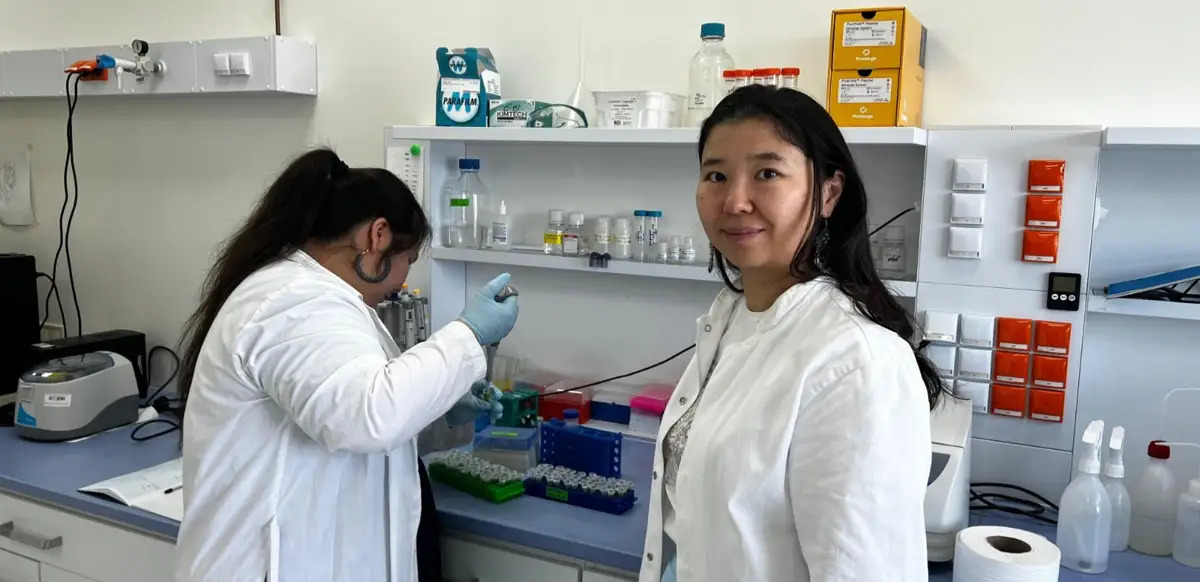
In the laboratory, students observe nanoparticles obtained from beets after roasting and grinding them, with the addition of certain chemicals. By selecting a certain dose of nanoparticles, young researchers achieve different effects on the plant body, identify its herbicidal properties, and study how nanoparticles affect different plant organs. The overall task is divided into subtasks, and each student works on his part independently.
An interesting project is the coursework of a student, whom Aigerim proposed to study the properties of the adraspan plant and compare it with varieties found in the East Kazakhstan region, Turkestan and Shymkent.
- Adraspan grows very slowly. Its capabilities in the fight against cancer cells and its bacterial and herbicidal properties were studied. Scientists in Almaty made morphological sections, but we want to study the plant at the molecular level and find out whether there are differences between the species. At first glance, the Turkestan branch branches differently. We will isolate proteins and then RNA. We also began to create a map of the distribution of this plant, we know it is found in Egypt, Turkey, China, northern Africa, Spain, and even found in Mexico,” Aigerim said.
She recently published an article on sugar starvation in plants, and at the same time, she is conducting a small project together with the Burabay National Park.
- We determine the death of trees at the molecular level. We collected branches of trees of different ages, from 20-year-old trees to 210-year-old pine. From the samples taken, we extract DNA and RNA for comparison and will then try molecular markers. Our task is to carry out molecular certification; in general, the project is comprehensive and is aimed at maintaining the park, which includes the study of underground and above-ground waters, plants, and so on. A colleague from Pavlodar uses the ring dendrogram method to determine in which years there were droughts and other disasters in order to compare them with cartographic data and use them as a marker to determine past events, and, well, age. Such work will prevent fires and improve the green fund of the park, notes Aigerim Soltabaeva.
She also helps colleagues from Gumilev ENU on a project on barley resistance to heat and drought. By studying the molecular mechanism of the involvement of certain genes, scientists recognize their characteristics and can then mutate the plant, making it more stress-resistant.