
2024, June 28
Share this articleEPFL Team, Including NU Professor Bakhtiyar Orazbayev, Develops Groundbreaking Soundwave Technology for Biomedical Applications
In a significant leap for biomedical technology, researchers from the École Polytechnique Fédérale de Lausanne (EPFL) have successfully navigated floating objects around an aquatic obstacle course using only soundwaves. This innovative method, inspired by optics and developed with contributions from Nazarbayev University (NU) Professor Bakhtiyar Orazbayev, shows immense potential for noninvasive targeted drug delivery and other biomedical applications.
Optical tweezers, which earned Arthur Ashkin the Nobel Prize in Physics in 2018, manipulate microscopic particles with laser beams but require highly controlled conditions. “Optical tweezers work by creating a light ‘hotspot’ to trap particles, like a ball falling into a hole. But if there are other objects in the vicinity, this hole is difficult to create and move around,” explains Romain Fleury, head of EPFL’s Laboratory of Wave Engineering.
Fleury, along with postdoctoral researchers Bakhtiyar Orazbayev and Matthieu Malléjac, has spent the last four years developing a method to move objects in uncontrolled, dynamic environments using soundwaves. This method, called wave momentum shaping, relies solely on the object's position, allowing soundwaves to guide its movement regardless of the environment or physical properties.
“In our experiments, instead of trapping objects, we gently pushed them around, as you might guide a puck with a hockey stick,” Fleury elaborates.
The novel approach, funded by the Swiss National Science Foundation (SNSF) Spark program, has been published in Nature Physics. The project was a collaborative effort with researchers from the University of Bordeaux in France, Nazarbayev University in Kazakhstan, and the Vienna University of Technology in Austria.
Simple Yet Promising Method
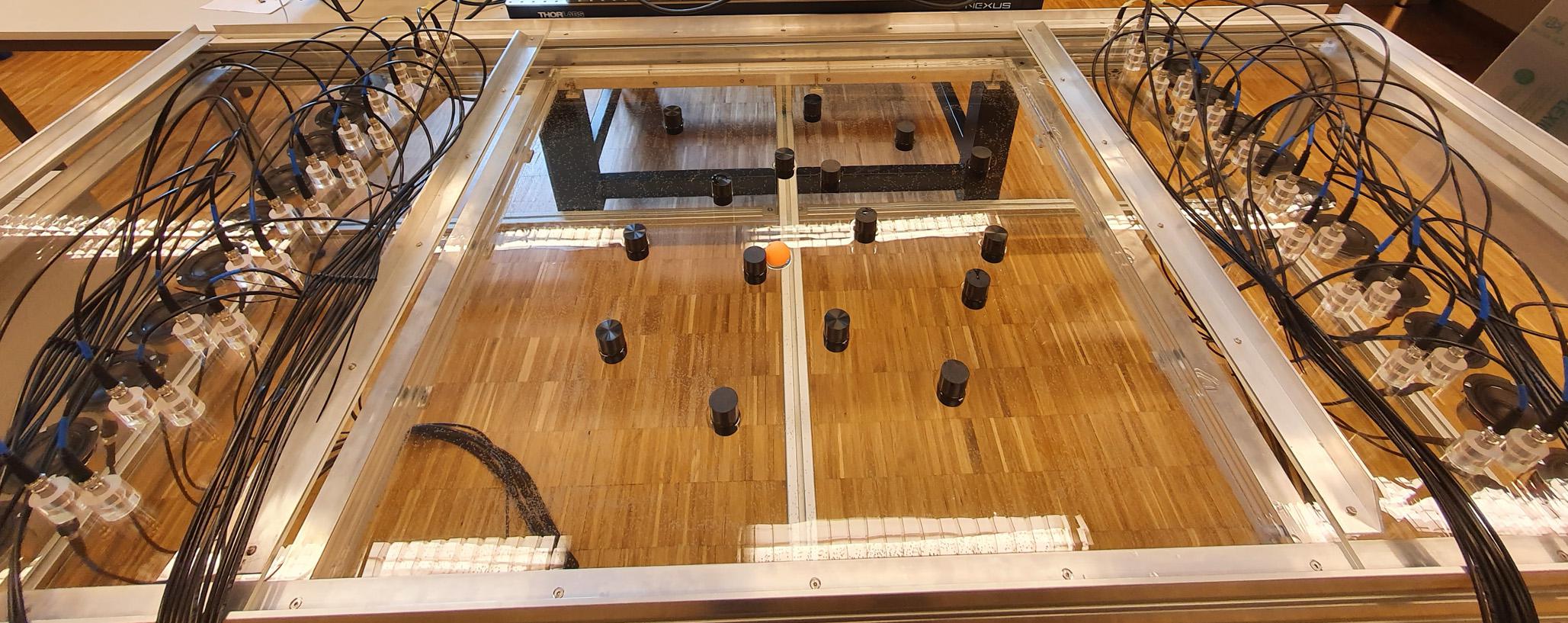
In the lab’s experiments, a ping-pong ball was floated on water and its position tracked by an overhead camera. Audible soundwaves from speaker arrays at either end of the tank directed the ball along a pre-determined path. Microphones recorded the feedback as the soundwaves bounced off the moving ball, allowing real-time calculations of optimal soundwave momentum to guide the ball.
“The method is rooted in momentum conservation, making it extremely simple and general, which is why it’s so promising,” Fleury states.
The researchers successfully navigated the ball around both stationary and moving obstacles, demonstrating the method's potential in dynamic, uncontrolled environments like the human body. Sound, being harmless and noninvasive, makes it an attractive tool for biomedical applications, such as directing drug delivery to tumor cells.
Future Applications and Research
Beyond drug delivery, wave momentum shaping could revolutionize biological analysis, tissue engineering, and even 3D-printing. The researchers are now looking to scale down their experiments to the microscopic level, using ultrasonic waves to move cells, funded by additional SNSF grants.
Professor Bakhtiyar Orazbayev’s contributions were pivotal in this groundbreaking research, showcasing NU’s commitment to global scientific advancements. This work not only highlights the international collaboration between institutions but also sets the stage for future innovations in the biomedical field.